What is the Dualoo Recruiting Report 2026?
The Dualoo Recruiting Report 2026 analyzes 274,090 anonymized job applications from July 1, 2025, through June 30, 2026. It shows on which days of the week, at what times, and during which periods of the year applicants submit applications. Using this data, HR teams can better plan their processes, resources, and response times.
Key Findings at a Glance
The 2026 Recruiting Report reveals clear patterns in job application behavior:
- 37.8% of all applications are received on Monday and Tuesday.
This makes the start of the week the busiest time for applications. - 58.6% of all applications are submitted between 8 a.m. and 4 p.m.
The peak in applications is not in the evening, but in the middle of the day. - Nine of the 10 busiest weeks for application receipts fall between January and May.
The beginning of the year and spring are particularly busy periods for application receipts.
Why the Timing of Your Application Matters in the Hiring Process
Timing plays a bigger role in recruiting than many companies realize. This is because applications are not distributed evenly across days, times, and seasons. That’s why it’s worth taking a closer look at typical application patterns.
This raises some important questions for HR teams: When do applications come in? On which days of the week are candidates particularly active? And during which times of the year does the volume of applications increase?
The Dualoo Recruiting Report 2026 provides answers to these questions. The analysis shows, on the one hand, when applicants submit their applications. On the other hand, it highlights what HR teams can learn from this information to inform their day-to-day recruiting efforts. This allows for better planning of processes and earlier identification of application peaks.
The Start of the Week Is Key in Recruiting
The data shows a clear pattern: A particularly large number of applications are received at the beginning of the week. Monday and Tuesday are the busiest days for applications.
On Monday, 52,280 applications were submitted. Tuesday followed closely behind with 51,224 applications. Together, these two days account for 37.8% of all applications.
Job applications are clearly a weekday phenomenon. 84.3% of all applications are submitted Monday through Friday. Only 15.7% are received on the weekend. The slowest day is Saturday, at 6%.

Takeaways for HR Teams
Many candidates are taking advantage of the weekend to get involved. They search for jobs, review advertisements, and finalize their application materials. They then often submit their applications at the start of the week.
This is important for HR teams. That’s because, especially on Mondays and Tuesdays, they have to review, respond to, and forward many new applications internally. Those who respond quickly at the start of the week can engage applicants sooner. This also improves the candidate experience.
Practical Tips for HR Teams
1. Consciously reserve Monday and Tuesday for job applications.
Schedule fixed time slots for new applications on Monday and Tuesday. A larger number of applications may have accumulated, especially after the weekend.
2. Review advertisements before the weekend
Ideally, review open jobs toward the end of the previous week. Are the advertisements up to date? Do the links and forms work? Are the requirements clearly stated?
Job applications aren't just something people do after work
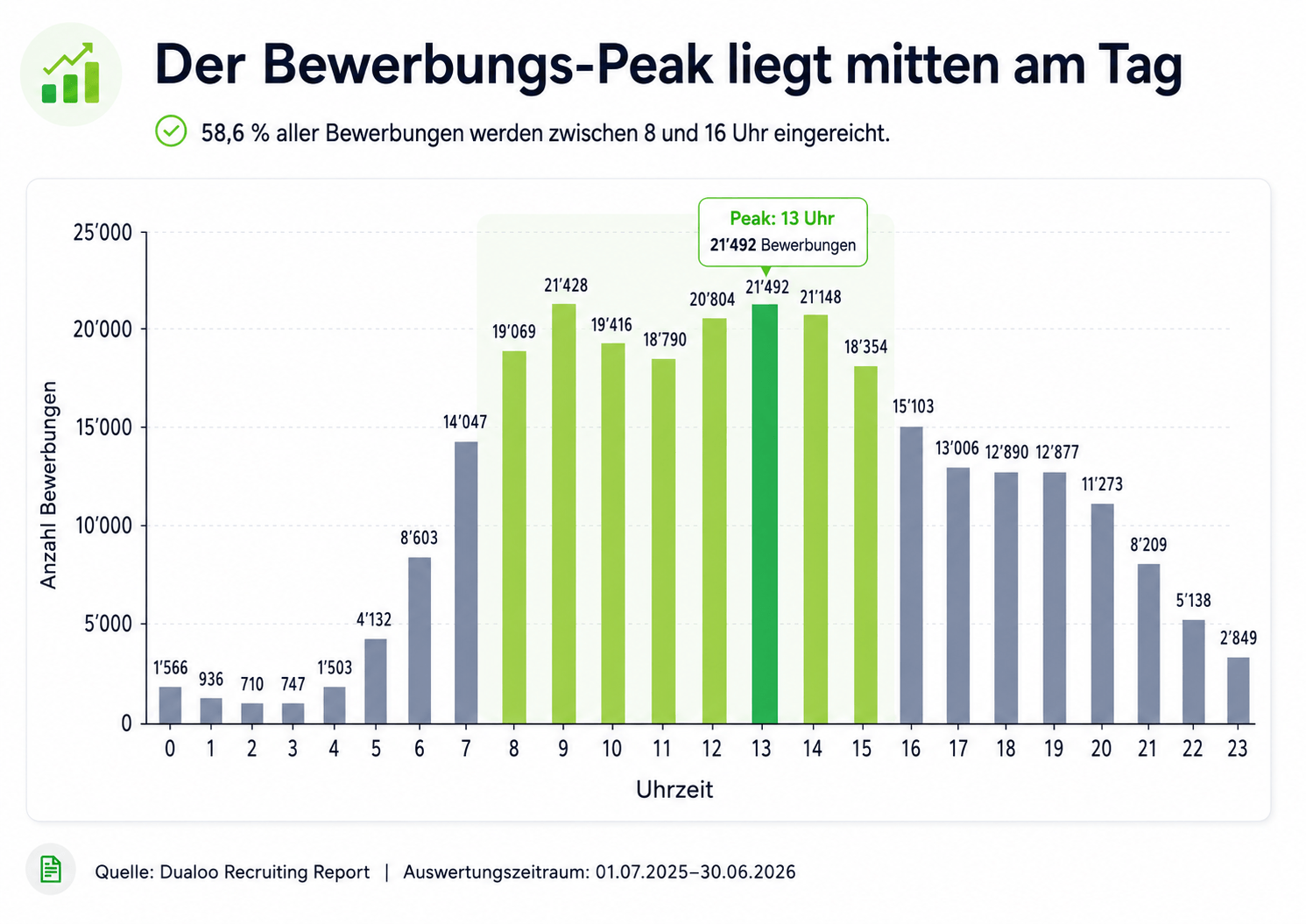
The highest volume is recorded between 1:00 p.m. and 2:00 p.m. During this time, an average of 7.8% of all applications are received. The morning and early afternoon also see an increase in volume.
The eight busiest hours are between 8 a.m. and 4 p.m. Together, they account for 58.6% of all applications. Applications are therefore not just an after-work phenomenon.
At the same time, the application process remains important even outside of traditional office hours. This is because 35.9% of all applications are still submitted outside of the 8 a.m. to 5 p.m. window.
Takeaways for HR Teams
Application processes must run efficiently during the day. At the same time, applicants must be able to submit an application at any time.
Many applicants expect the process to be straightforward. This is true regardless of whether someone in HR is currently available. That’s why digital processes, clear forms, and automated communication are crucial.
Practical Tips for HR Teams
1. Keep application forms short and easy to understand
If you receive many applications throughout the day, the process needs to be simple. Avoid unnecessary required fields and duplicate data entry.
2. Thoroughly test the mobile application process
Many applicants apply on the go. Therefore, make sure the application process works smoothly on a smartphone.
3. Use automated communication outside of office hours
HR teams cannot respond personally at all times. Nevertheless, candidates should receive immediate feedback. An automated acknowledgment of receipt is essential for this.
With Dualoo, processes remain organized even when there is a high volume of applications.
Seasonality in Recruiting: More Applications in the First Half of the Year
An analysis by week shows that applications are not distributed evenly throughout the year. The average number of applications per week is around 5,172. However, there are certain periods that deviate significantly from this average.
Particularly noticeable is the higher volume of applications in the first half of the year. Between January and May, there are several weeks with an above-average number of application receipts.
Toward the end of the year and during the summer, however, the volume drops significantly. This is especially true during the weeks of the Christmas and summer breaks.

Takeaways for HR Teams
Recruiting isn’t equally intense throughout the year. Some weeks bring in significantly more applications. Other periods are quieter.
It is therefore worthwhile for HR teams to plan campaigns, internal resources, and decision-making processes on a seasonal basis. Thorough preparation is particularly important. After all, a high volume of applications is only beneficial if HR teams can process them efficiently.
Practical Tips for HR Teams
1. Align your planning with seasonal peaks
Make a point of scheduling important job postings around periods of high application activity. January through May, in particular, can be good times for this.
2. Secure internal resources early on
If a large number of applications is expected, everyone involved needs enough time. This includes HR, subject matter experts, and decision-makers.
3. Prepare Templates and Evaluation Criteria
Standardized e-mail templates, clear evaluation criteria, and defined process steps help when dealing with high volumes. This ensures that the recruiting process remains professional and transparent.
4. Take vacation and holiday periods into account
Jobs can still be published during slower weeks. However, expectations regarding response rates and response times should remain realistic.
5. Use reporting regularly
Regularly compare application volumes, channels, and response times. This will help you identify when your company receives a particularly high number of applications. It will also show you where processes can be optimized.
Conclusion: Timing makes recruiting more predictable
The Dualoo Recruiting Report 2026 shows that job applications are not distributed randomly. They tend to occur more frequently at the start of the week, reach their daily peak around noon and in the early afternoon, and vary significantly depending on the time of year.
For HR teams, this means that those who plan recruitment processes based on data can respond more quickly. It also allows them to better support candidates and streamline internal processes.
Digital recruiting processes support this planning. They help you manage applications centrally, automate communication, and maintain an overview even when the volume of applications is high.
Note on the Data Source
The analysis is based on 274,090 anonymized applications from over 350 Dualoo customers. The applications were submitted via Dualoo between July 1, 2025, and June 30, 2026. The data comes primarily from the Swiss SME sector.
The results reveal patterns within this dataset. They serve as a guide for planning and optimizing processes. The figures may vary depending on the industry, company size, target audience, region, and recruitment channel.
This analysis does not claim to be universally applicable or exhaustive. Furthermore, it does not constitute a binding forecast for individual companies, industries, or recruiting processes.
Questions & Answers: 2026 Recruiting Report
What is the Dualoo Recruiting Report?
The Dualoo Recruiting Report is a concise analysis of 274,090 applications. It shows when applicants submit their applications. The analysis examines days of the week, times of day, and calendar weeks. This provides HR teams with specific recruiting metrics to aid in their planning.
Why is the timing of an application important in the recruiting process?
The timing of applications reveals when applicants are particularly active. When HR teams are aware of these patterns, they can plan their resources more effectively and respond more quickly. This knowledge also helps them identify application peaks early on and improve the candidate experience.
How can HR teams respond to peaks in job applications?
HR teams can better manage peaks in applications by preparing roles and responsibilities, templates, and automated processes. Setting aside specific time slots for new applications—especially on Mondays and Tuesdays—is particularly helpful. Automatic acknowledgments of receipt and clear internal workflows provide additional support.
What role does seasonality play in recruiting?
Seasonality plays an important role in recruiting because the volume of applications is not evenly distributed throughout the year. The 2026 Recruiting Report highlights several weeks with a high volume of applications between January and May. Therefore, HR teams should plan job postings, campaigns, and resources with seasonality in mind.
Why is digital applicant tracking helpful when there is a high volume of applications?
Digital applicant tracking helps companies centrally capture applications and process them in a structured manner. This allows HR teams to maintain a clear overview, especially during periods of high application volume. Applicant tracking software helps companies efficiently manage communication, internal ratings, and next steps.